Mantra & Yantra library
Traditional texts with meaning, source and licence

| Text | Type | Source | Licence |
|---|---|---|---|
| Gayatri Mantra | Mantra | Rigveda 3.62.10 (traditional Vedic text) | Public domain (traditional) |
| Mahamrityunjaya Mantra | Mantra | Rigveda 7.59.12; also Yajurveda (traditional Vedic text) | Public domain (traditional) |
| Vakratunda Mahakaya (Ganesha Shloka) | Mantra | Traditional Ganesha shloka (oral tradition) | Public domain (traditional) |
| Ya Kundendu (Saraswati Vandana) | Stotra | Traditional Saraswati stuti (oral tradition) | Public domain (traditional) |
| Navagraha Mantra | Mantra | Traditional Navagraha shloka | Public domain (traditional) |
| Sarve Bhavantu Sukhinah | Mantra | Traditional shanti (peace) verse | Public domain (traditional) |
| Om Jai Jagdish Hare (Aarti) — opening verses | Aarti | Pandit Shardha Ram Phillauri (1837–1881); public domain | Public domain (traditional) |
| Twameva Mata | Stotra | Traditional prayer verse (oral tradition) | Public domain (traditional) |
Yantra: reading the Sri Yantra
Sri Yantra
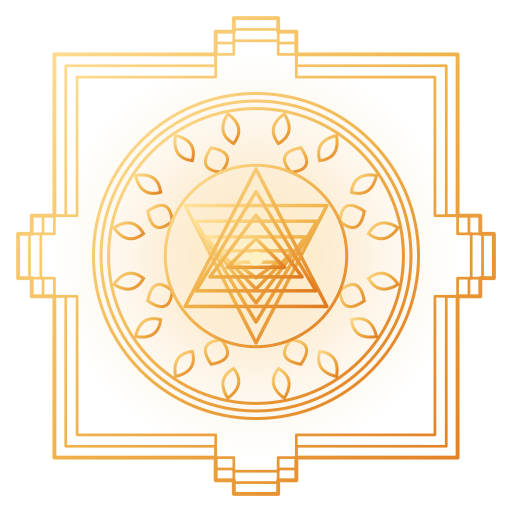
The Sri Yantra (Sri Chakra) is formed by nine interlocking triangles — four pointing up and five pointing down — which create 43 smaller triangles around a central point (bindu). They are surrounded by an eight-petal and a sixteen-petal lotus, three circles and a square enclosure (bhupura) with four gates.
Source: Sri Vidya tradition (traditional symbolism). The drawing on this site is original artwork.
Bindu
The central point, understood as the source from which the whole figure unfolds. Meditation traditionally moves from the outer square inward to the bindu.
Source: Traditional symbolism
Bhupura
The outer square with four T-shaped gates facing the four directions — the “earth” enclosure that marks out sacred space.
Source: Traditional symbolism
Yantras are devotional and meditative objects. This site does not sell yantras and makes no claims about their effects.
